Asawari Luthra joined the GLOBALISE project as a guest researcher in the period June 2024 – May 2025. Trained as both a historian and anthropologist, she conducted ethnographic research to explore how access to GLOBALISE’s digital infrastructure can be made safer and more decolonised. Through interviews with archivists, historians, artists, and community members from diverse backgrounds, she gathered insights into the emotional and political impact of engaging with colonial archives. GLOBALISE will build on her thoughtful recommendations in its ongoing development, while also acknowledging that not all suggestions can be implemented within the current scope of the project.
The stories keep coming. A design student from Latin America breaks down crying during an archival introduction, listening to a curator casually drop racial slurs while describing historical maps. A Dutch child becomes physically ill looking at illustrations of enslaved people packed into ships. Researchers regularly ‘break down’ in reading rooms while accessing colonial materials.
These are not isolated incidents from decades past – they are happening today, in 2025. Each breakdown reveals the same truth: archives created to serve the empire continue to wound the very people they once documented, controlled, or silenced.
My journey into reimagining the GLOBALISE project began with a simple question: As digitisation makes colonial archives more accessible than ever before, how do we make them accessible without causing harm?
The Weight of History
All archives carry biases, but those created during imperial expansion contain particularly harmful language and perspectives. These biases are not just academic concerns; they have real emotional impact on contemporary users. When that Latin American student listened to a curator describe people not as ‘seeking freedom’ but as ‘escaping’, something fundamental shifted in the room. The past wasn’t the past anymore – it was present, breathing, hurting.
When descendants of enslaved peoples, colonised communities, or even empathetic visitors encounter these materials, they are forced to see their ancestors – or fellow humans – through the dehumanising lens of their oppressors. The Dutch clerk writing ‘escaped slaves’ saw runaways, not freedom seekers. His ‘troublesome natives’ were what we might today call resistance fighters.
Yet these are the very documents we are now digitising, making searchable and shareable, carrying their original prejudices into digital interfaces never designed to hold such pain.
What GLOBALISE Gets Right
The GLOBALISE project deserves credit for trying. They have assembled a diverse team that includes scholars from the many different countries represented in the archives, created contextual warnings about offensive content, and are building better search tools to ask new questions and tell new stories. They are being ‘very very upfront about what are the biases that you are encountering’, which is more than most institutions manage.
My interviews with archivists, curators, and researchers highlighted other technical solutions that can provide safer access: navigational aids for non-expert users, trigger warnings, multiple entry points, emotional check-in prompts, tutorials, and simple guides explaining how to use translation tools with historical documents.
These improvements matter. They represent genuine attempts to make colonial archives less harmful and more useful. But technical solutions, however thoughtful, can only go so far when the fundamental problem is structural. Better search engines don’t change whose voices are in the archive. Bias warnings don’t restore missing perspectives. We cannot simply digitise our way out of colonialism.
Beyond Technical Fixes
This became clear through my conversations with people doing this work. The design student channeled her archival breakdown into performance art, creating a character based on La Llorona – the weeping woman of Latin American folklore – and walking through the same archives that had traumatised her.
‘My project in the archive is about bringing people to cry’, she told me, ‘because we haven’t made the proper mourning of this era. And we just keep going as if it was nothing but there is a lot of pain behind them. Still, we can feel it these days.’
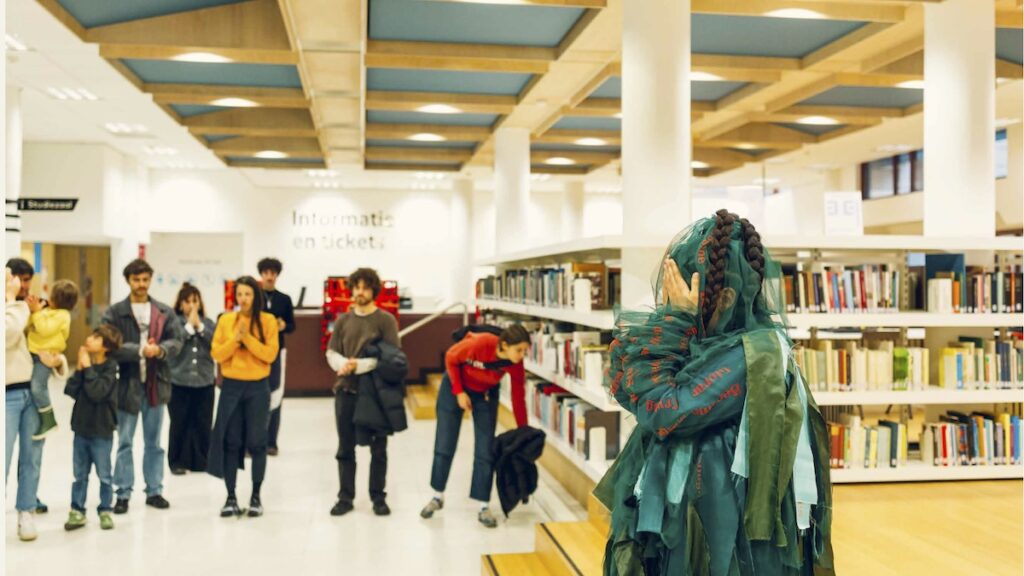
Performance by Juliana Acero Castellanos (Non-linear Narrative, Royal Academy of Art, The Hague). Presented at Archival Frictions, The Hague. Photo: Matteo Montalvo.
Another insight came from a curator who worked on projects where communities were not just consulted but given genuine authority over their own narratives. She described how ‘for the communities, it was very important to have their narratives told in a certain way […] when it was about colonialism, there always was the view that things like resistance should take the lead. And it should not be a story about victimhood.’
This crystallized something crucial: reinterpretation and filling in the missing voices can be a form of healing. Communities need spaces where they can grieve, rage, reclaim, and ultimately transform their relationship with these materials.
The Work Ahead and Why It’s Hard
My conversations revealed what true transformation could look like, but also why it remains challenging. It would mean communities controlling how their materials are digitised, described, and shared. It would mean archives structured around community needs rather than academic convenience alone. It would mean funding models that support relationship-building rather than just project completion.
As one researcher told me, decolonisation isn’t a theory – ‘it is something that we need to live right? It’s the practice of critically thinking about what Europe has told us’ while working to ‘empower basically those who have been silenced by the dynamics of the colonial power […] in a collaborative, equally horizontal, way of thinking.’ This is not about making existing systems more inclusive; it’s about transferring power. And that’s precisely why it’s so hard.
But here is what I learned: our institutions are not structured for this kind of work. Community partnerships often emerge from scheduling needs rather than genuine commitment. As one curator candidly described: ‘They invited us to make an exhibition and umm yeah, they had a gap in their programming and then they thought, okay, let’s fill the gap, and ask communities to make an exhibition with us or for us.’
The most successful partnerships I heard about involved years of relationship-building, not months. Yet funding cycles reward innovation over sustainability, leaving promising partnerships to wither when grants end. This treats community voices as content to fill institutional spaces rather than authorities with decision-making power over their own histories.
The Hardest Questions
The hardest questions are not technical; they are about power. Who gets to control these materials?
Many archival materials are not simply historical artifacts – they are still alive and important today. In Latin American indigenous communities, traditional maps are not simply territorial records but active participants in rain ceremonies, carried up mountains during rituals. ‘They are living documents because they do not only speak about the rights of land’, a researcher explained, ‘but they might take these documents to petition for rain.’
When institutions digitise such materials without community input, they are making unilateral decisions about living cultural heritage that isn’t theirs. Many communities only discover their sacred objects in foreign archives when digitisation makes them visible online. ‘When you actually talk with the communities’, one researcher observed, ‘they actually care very much about them […] in the moment that they realise that they are somewhere else, why would you not want to have documents of your great grandparents?’
True governance would mean communities control materials that were, as one researcher noted, ‘extracted violently.’ They should decide if their cultural materials get digitised at all, how they are described and contextualised, and who gets to see them. Until communities have this power, digitisation will keep repeating the same colonial story – taking without asking, deciding without consulting, extracting without returning.
What It Will Take
The question is not whether we can build better colonial archives. It is whether we can build something entirely different: participatory spaces where historical trauma transforms into collective healing, where silenced voices claim interpretive authority, and where breaking hearts find the support they need to mend.
This requires institutional courage. The technology exists. The communities are ready. What’s missing is the willingness to restructure funding models, evaluation metrics, and decision-making processes to genuinely share control over stories that were never ours alone to tell.
Sometimes the most important changes begin with someone crying in a reading room, refusing to accept that this is just how things are. Sometimes they begin with a digital post-it note stuck to a centuries-old document, saying: ‘This is not how we remember it.’
The archives will keep breaking hearts until we stop asking how to make colonial collections more accessible and start doing the work to make knowledge systems more just. Some problems can be solved with better technology. Others require us to question who gets to control the past – and act on those answers.