Upcoming events
Past events
- GLOBALISE Conference – 3-6 March 2026, Amsterdam
We are pleased to announce the GLOBALISE Conference
Colonial Pasts, New Approaches and Historiographical Futures:
Explorations of GLOBALISE, the Dutch East India Company Archives and the writing of new historiesto be held from 4 to 6 March 2026, with pre-conference activities on 3 March.
Update 4 March 2026, 10:00. We are currently experiencing Zoom difficulties.
We will be sending registered participants a new Zoom link. If you have not received it, please contact us through our contact form. Sorry for the inconvenience. Our contact form inbox is monitored regularly throughout the duration of this conference.
Update 3 March 2026: the conference booklet, which includes the full program and abstracts for all papers, is now available to download or view online.
The archives of the Dutch East India Company (VOC) offer crucial insights into both Dutch colonialism and the histories of early modern societies in Africa, Asia, and Australia. Traditional historiography has focused on trade and European actors, often overlooking the VOC’s colonial governance, exploitation, and the resilience of local communities. Recent approaches in area studies and global history have used the VOC archives to explore these overlooked dimensions.
The GLOBALISE project is transforming historical research by digitizing and enriching VOC archives through technologies like machine-readable transcriptions and historical contextualization. This opens new possibilities for writing inclusive, comparative, and long-term histories that integrate colonial, global, and vernacular perspectives.
This conference aims to open up discussions about how digital tools and multiple archival sources – both colonial and vernacular – can reshape the way we study the VOC, the Indian Ocean World, and broader patterns of global exchanges and colonial encounters.
Conference venue (map):
International Institute of Social History
Cruquiusweg 31
1019 AT AmsterdamConference Schedule
Note: This program is continually being updated and may still be subject to change.
Tuesday 3 March 2026 Pre-conference Activities
Time Venue 13.00 – 13.15 Welcome and coffee 13.15 – 14.15 Getting to know GLOBALISE sessions 1-3 Parallel rooms 14.15 – 14.30 Short break Vide 14.30 – 15.30 Getting to know GLOBALISE sessions 1-3 Parallel rooms 15.30 – 17.00 Walking tour Tour starts at IISG Wednesday 4 March 2026 Conference Day 1
Time Venue 08.30 – 10.00 Registration and coffee Vide & entry hall 09.00 – 10.00 Getting to know GLOBALISE sessions 1-3 Parallel rooms 10.15 – 10.30 Short welcome Max Nettlau 10.30 – 12.00 Parallel session 1 Parallel rooms 12.00 – 13.00 Lunch Max Nettlau/Vide 13.00 – 14.00 Keynote Lecture: Matthias van Rossum Max Nettlau 14.00 – 14.45 GLOBALISE project update Max Nettlau 14.45 – 15.00 Short break Max Nettlau/Vide 15.00 – 16.30 Parallel session 2 Parallel rooms 15.00 – 16.30 Workshop: Outsmarting the Machine Souvarine 16.30 – 16.45 Short break Max Nettlau/Vide 16.45 – 17.00 Short reflection on Day 1 Max Nettlau 17.00 – 18.00 Roundtable 1: Global Histories and the Digital Turn Max Nettlau 18.00 – 18.30 Performance lecture by TogetherTogether: Acero, Catani & Gaspar.
Farewell: An Imagined Response to Dutch Colonizers.Meeting point: registration desk 18.00 – 19.30 Drinks Max Nettlau Thursday 5 March 2026 Conference Day 2
Time Venue 09.00 – 10.40 Parallel session 3 Parallel rooms 10.45 – 12.00 Keynote Lecture: Ann Laura Stoler
ON BEARING ARCHIVAL TRUTHS
THEIR BURDENS OF COLONIAL PROOFMax Nettlau 12.00 – 12.30 Short lunch Max Nettlau/Vide 12.30 – 13.00 Performance lecture by Roelof Petrus van Wyk. AN UNNATURAL HISTORY, A Performance Lecture. Fugitive Desire under VOC Capitalist Erasure, made legible with Artistic Research methods by excavating the Sodomy Criminal Case records in the Colonial VOC Archive, Cape Town, 1652-1795. Posthumus 12.30 – 13.00 Performance lecture by Carmen Draxler.
»Mother-of-Oil« Colonial roots of the oil company Shell in Indonesia.Meeting point: registration desk 13.00 – 14.30 Parallel session 4 Parallel rooms 13.30 – 14.00 Performance lecture by Carmen Draxler.
»Mother-of-Oil« Colonial roots of the oil company Shell in Indonesia.Meeting point: registration desk 14.30 – 15.00 Coffee break Max Nettlau/Vide 14.30 – 15.00 Performance lecture by Carmen Draxler.
»Mother-of-Oil« Colonial roots of the oil company Shell in Indonesia.Meeting point: registration desk 15.00 – 16.45 Parallel session 5 Parallel rooms 16.45 – 17.00 Short break Max Nettlau/Vide 17.00 – 17.15 Short reflection on Day 2 Max Nettlau 17.15 – 18.15 Roundtable 2: Decolonizing Infrastructure, Engaging Communities Max Nettlau Drinks in the venue lobby from 19.00
Dinner starts 19.30Conference dinner * Kompaszaal *The conference dinner is for speakers, chairs and invited guests only.
Friday 6 March 2026 Conference Day 3
Time Venue 09.00 – 10.45 Parallel session 6 Parallel rooms 09.00 – 10.30 Workshop: Outsmarting the Machine Souvarine 10.45 – 11.00 Short break Max Nettlau/Vide 11.00 – 12.00 Keynote Lecture: Tonio Andrade
The Art and Peril of Being in Between: Reflections on Cultural Brokers and the Dutch East India CompanyMax Nettlau 12.00 – 13.30 Closing Roundtable and Plenary Reflection: Colonial Pasts, Empowering Futures Max Nettlau 13.30 – 14.30 Lunch Max Nettlau/Vide
Keynote Lectures
Ann Laura Stoler, The New School for Social Research
ON BEARING ARCHIVAL TRUTHS
THEIR BURDENS OF COLONIAL PROOFThis reflection derives from decades working on the politics of truth in shaping imperial governance and its hierarchies of credibility, as manifest in Dutch and French colonial contexts of the late 19th and early 20th century. It’s a project that asks how those who govern know what they know, how arbitrators of truth imagine how they know, what constitutes evidence of what they profess to know, and what they claim as proof when what they profess to know, they do not.
If the archival documents are, as the luminous French feminist historian Arlette Farge once argued, “a tear in the fabric of time, an unplanned glimpse offered into an unexpected event,” they are indeed as much a tear in the fiction of reason, often in collision with the regimes of truth that dictate causal arrows and linear sequence, closer to how Foucault defined an event, as a breach of the self-evident and common sense.
In this reflection, I call upon a set of scenes where “proof” and “truth” put demands on what is known, by whom, how and in what way. In pursuing micro-fissures in the edifice of imperial rule, I turn to sense and sensibility, to the texture of the detail shaping what we think we know of imperial formations past and present, and among those with resurgent and recursive durabilities today.
Ann Laura Stoler is Willy Brandt Distinguished University Professor of Historical Studies and Anthropology at The New School for Social Research where she is founding director of The Institute for Critical Social Inquiry and founding co-editor of journal, Political Concepts: A Critical Lexicon. Her work on the politics of archives, imperial debris, a colonial reading of Foucault’s History of Sexuality, on grammars of time, and the politics of sentiment have been guided by an effort to understand and confront the hypervisibility and invisibility of infrastructures of inequality. Her books include Along the Archival Grain: Epistemic Anxieties and Colonial Common Sense (2009), and Capitalism and Confrontation in Sumatra’s Plantation Belt, 1870–1979 (1985; 1995), Race and the Education of Desire: Foucault’s History of Sexuality and the Colonial Order of Things (1995), as well as the edited volumes Tensions of Empire: Colonial Cultures in a Bourgeois World (with Frederick Cooper, 1997) and Imperial Debris: On Ruins and Ruination (2013).
Tonio Andrade, Emory University
The Art and Peril of Being in Between: Reflections on Cultural Brokers and the Dutch East India Company
Scholars have long recognized the Dutch East India Company’s dependence on local translators and cultural mediators. In this talk I plan to discuss three such figures who were active between 1633 and 1674: Krotoa Eva of the Cape of Good Hope, Osoet Pegua of Ayutthaya (Siam), and He Bin of Taiwan. Although they worked in vastly different contexts and faced unique challenges, their lives followed similar trajectories. Each rose to influence through linguistic and cultural skills that enabled them to mediate between Company officials and local populations. Each cultivated personal ties with Company officials that bypassed formal oversight. Each used these connections to accumulate wealth and influence, skillfully navigating internal fissures within both Company administration and local society. And each got into trouble with the Company on one hand and local groups on the other. This trouble generated documents – legal proceedings, seized letters, interrogations, and reports – that open a window onto the Company’s messy realities on the ground, reminding us of the importance of personal networks, unofficial dealings, and intimate relations to the entangled histories of the VOC and the societies it operated within.
Tonio Andrade (B.A., Reed College, 1992; M.A., University of Illinois Urbana-Champaign, 1994; M.A., M.Phil., and Ph.D., Yale University, 1997, 1998, and 2000) is a Professor of Chinese and Global History at Emory University. His major books include The Last Embassy: The Dutch Mission of 1795 and the Forgotten History of Western Encounters with China (Princeton, 2021), The Gunpowder Age: China, Military Innovation, and the Rise of the West in World History (Princeton, 2016), Lost Colony: The Untold Story of Europe’s First War with China (Princeton, 2011), and How Taiwan Became Chinese (Columbia University Press, 2007). He is author of more than thirty articles, which have appeared in such journals as The Journal of World History, Late Imperial China, Itinerario, and Journal of Asian Studies, among others. Honors include The John Simon Guggenheim Fellowship, The N.E.H. Public Scholars Fellowship, The Harry Frank Guggenheim Fellowship, and the American Historical Association’s Gutenberg-e Prize. He lives in Decatur, Georgia, with his family and enjoys advocating for safe and sustainable transportation.
Roundtables
Roundtable 1: Global Histories and the Digital Turn
Wed 4 March 17.00 – 18.00
Max NettlauChair: Guido van Meersbergen, Warwick University and Journal of Global History
Speakers:
Dagmar Freist, Carl-von-Ossietzky Universität Oldenburg, Prize Papers Project
Ana Sofia Ribeiro, Universidade de Évora, MONSOON project
Claude Chevaleyre, ENS de Lyon, China Human Trafficking and Slaving DatabaseHow can large archival, data and research projects reshape the practice and impact of global history writing?
This roundtable brings together leading scholars with related initiatives to the GLOBALISE project to discuss how these initiatives can fuel the field of global history through the accessibility of sources, the development of new research methods, and more.
Roundtable 2: Decolonizing Infrastructure, Engaging Communities
Thu 5 March 17.15 – 18.15
Max Nettlau / hybrid sessionChair: Wim Manuhutu, VU Amsterdam
Speakers:
Asawari Luthra, historian and anthropologist, GLOBALISE guest researcher
Yus Broersma, heritage practitioner and researcher
Wisaal Abrahams, visual artist
Charles Jeurgens, University of Amsterdam
Dutch Trading Post Heritage NetworkThis roundtable invites speakers to provide perspectives on working with communities, whether in cultural heritage, community engagement or archival practices. Together, we reflect on how archival infrastructures affect access to colonial archives, past and present. What does increased digital accessibility mean for communities with a stake in colonial archives? How might digital infrastructures move more meaningfully towards practices of care?
Plenary Discussion and Closing Roundtable: Colonial Pasts, Empowering Futures
Fri 6 March 12.00 – 13.30
Max NettlauChair: Lodewijk Petram, project manager GLOBALISE
Speakers:
Matthias van Rossum, project leader GLOBALISE
Lija Joseph, Leiden University
Anna Bruins, University of Warwick
Wenrui Zhao, University of Utah
Luc Bulten, Radboud University, NijmegenHow is digitization transforming the kinds of questions we can ask of colonial archives? What new research directions seem most urgent or promising after this conference, and what missing perspectives have become visible?
During this conference, speakers will have explored diverse ways to interpret and write new histories using the archives of the Dutch East India Company and beyond. The key themes of this conference include: the VOC archives and history writing, the VOC as a colonial power, decentering histories of the VOC, as well as digital approaches to colonial archives. In this closing roundtable, we envision an open discussion between panelists and conference attendees, inviting you to share your insights and to reflect collectively on how global history writing can move forward.
Overview of Panels
Session 1: Wed 4 March 10.30 – 12.00
Session 1A: Material Culture and Social Life
Nikolaevsky room
Chair: Tristan Mostert
Session coordinator: Nur’Ain TahaSession 1B: Mobilities
Max Nettlau room
Chair: Marieke Hendriksen
Session coordinator: Bente de LeedeSession 1C: Digital Humanities Approaches to the VOC Archive
Posthumus room
Chair: Stella Verkijk
Session coordinator: Bethany WarnerJosephine Koopman – Unboxing the VOC Archives: on the material culture of betel chewing
Isabelle Stone – Collecting Shells at a Cost: Johan Nieuhof’s Account of the Pearl Fishery at Toothukudi, 1664-1665.
Lodewijk Wagenaar – Character and remains of the VOC colony of Ceylon. An internet search.Roni Tabroni – The Nusantara Hajj Pilgrimage in the 17th and 18th centuries: The Emergence of a Global Ummah Identity.
Nikhil Bellarykar – Maratha overseas trade in the 17th century– tracing the ship Shambhu Prasad through the VOC archives.
Tom Hoogervorst – Globalise and Unlocked Food Archives.Willemien de Kock, Rob Lenders and Emin Tatar – Tracing Historical Tortoiseshell Exploitation and Trade through AI-Driven Analysis.
Andre Valdestilhas, Shuai Wang, Ronald Siebes and Angelica Maineri – Aggregating the FAIR Assessment Results of Datasets by the GLOBALISE Community for Evaluating FAIR Data Management.Session 2: Wed 4 March 15.00 – 16.30
Session 2A: The Dutch Reformed Church and Colonialism
Nikolaevsky room
Chair: Dienke Hondius
Session coordinator: Bente de LeedeSession 2B: Trade, Colonial Expansion and Glocal Networks
Max Nettlau room
Chair: Erik Odegard
Session coordinator: Britt van DuijvenvoordeSession 2C: Currencies, Politics and Labour
Posthumus room
Chair: Maarten Manse
Session coordinator: Vany SusantoJon Kuiper – The Dutch Reformed Church on Ambon (1605-1700): Creating Power Structures and Framing the Other.
Yudha Thianto – The VOC, the Church, and the Massacre of Banda in 1621.
Fred van Lieburg – A New Biographical Dictionary of Netherlands Indian Ministers, Sick-comforters and Missionaries 1600-1960.Ajay Joy Mathew – Between the Cartaz and the Zeebrief: The Zamorin’s Maritime Diplomacy, 1633-1766.
Luc Bulten – The Making of Colombo: Dutch and Lankan Engineering, Infrastructures and Commodity Trade, 1745-1795.
Marsely Kehoe – Exploring Global Textile Circulation with the Dutch Textile Trade Project.Nurman Kholis – “Duit” and “Dirham”: A Preliminary Study on The Arabic Scripts in VOC-Dutch East India Coins in Java in 18th and 19th Centuries.
Maarten Draper – The Travails of Paper Currency in the Dutch Indian Ocean, 1780-1825.
Jan Lucassen – The deep monetization of India and changing labour relations 1500-1900.Session 3: Thu 5 March 09.00 – 10.40
Session 3A: Mediators, Knowledge and Contestation
Nikolaevsky room
Chair: Jos Gommans
Session coordinator: Muhammad AsyrafiSession 3B: Global-Micro Histories and Colonial Structure
Max Nettlau room
Chair: Nira Wickramasinghe
Session coordinator: Britt van DuijvenvoordeSession 3C: (Re)Connecting Histories – VOC, Atlantic and Iberian empires
Posthumus room
Chair: Pepijn Brandon
Session coordinator: Bethany WarnerMichael C. Reidy – Locally-based intermediaries and foreign agents during the VOC’s slave trading commissions in the eighteenth-century Indian Ocean.
Huang Xianting – Circulation of Camphor in the VOC World: Trade, Knowledge and Representation in Networks.
Romée van Oostenbrugge – At the Margins of European Knowledge: Local Guides’ Contributions to VOC Navigation During the Eighteenth Century.
Maarten Manse – Recasting the Terms of Empire: Indigenous Translators and Scribes in the VOC Archives, and how they mediated the legal vocabulary through Treaty Making in Southeast Asia.Byapti Sur – Local Lives, Global Stories: Studying the VOC Factories in Bengal, 1600-1800.
Rivindu de Zoysa – Carel de Mirando: A Microhistory of the Service of an Administrative Official in Dutch Ceylon.
Ann Heylen – Women in the VOC Archive: Patriarchy and Presence in Dutch Formosa.
Rosalie Oudshoorn – Succession, adoption, and power: Ranis in Malabar during the Dutch period.Guido van Meersbergen – Tracing Diplomatic Intermediaries in the VOC archives.
Zhonghua Du – Planting Addictions: Opium Trade and the Colonial Expansion of the VOC in Asia.
Nicholas C. Sy – The Asian Enslaved at the Intersections between European Archives, ca. 1663.Session 4: Thu 5 March 13.00 – 14.30
Session 4A: Memory, Culture and the Archive
Nikolaevsky room
Chair: Lotte Baltussen
Session coordinator: Bethany WarnerSession 4B: Local Diversities and Colonial Tensions
Max Nettlau room
Chair: Kathryn Wellen
Session coordinator: Louie BuanaSession 4C: Commodity Frontiers, Environment and Resistance
Posthumus room
Chair: Catia Antunes
Session coordinator: Pichayapat NaisupapDondy Pepito Ramos – From Archives to Artefacts: Negotiating VOC Cultural Memories in Australia through the Dutch Shipwreck Artefacts.
Nelo A. Schmalen – Decentering Colonial Histories through the City as an Archive.
Poorvi Prabhakar Garag – Unravelling Lifeworlds: Farmers and Consumers of Black Pepper.Lap Kan Au – The Two Fates of Plural Societies Reconsidered: Actor-Centered Performative Reproduction of VOC Plakkaaten in Seventeenth-Century Cape and Formosa.
Benjamin J.Q. Khoo – Murder in the Plantations: The Chinese Civil War on Riau (1786-92).
Lija Mary Kambakkaran Joseph – Mapping the Everyday Lives of a Subaltern Community: The Mukkuvas of Malabar in the VOC Archives.Jens Aurich – By All Means Necessary: The Organization of Indigo Production and Resistance under the VOC.
Linu Danielkutty – Spice Routes to Scarred Landscapes: How Dutch Colonial Corporation reshaped world landscapes.
Kathleen Burke – Trans-imperial Travels: The Quest to Commodify Cacao in Island Southeast AsiaSession 5: Thu 5 March 15.00 – 16.45
Session 5A: Material Culture, Knowledge and Circulations
Nikolaevsky room
Chair: Alicia Schrikker
Session coordinator: Pepijn TrienekensSession 5B: Colonial Exploitation: Land and People
Max Nettlau room
Chair: Joris van den Tol
Session coordinator: Ryhan M. YazidSession 5C: Science, Environment, and Colonial Histories
Posthumus room
Chair: Jessie Wei-Hsuan Chen
Session coordinator: Nur’Ain TahaPham Thuy Dung – Symbolic Adoption of Dutch East India Company Merchants: Two Cases from Seventeenth-Century Vietnam.
Ziquan Zhou – Sappanwood for the King’s Debt: Material and the Struggling Cooperation between the VOC and the Siamese Court in the Early Eighteenth Century.
Philipp Huber – All Political Power comes from the Barrel of a Gun: Arms Trading, Gun Control, and Revolt in Ayutthaya, 1656-1709.Wenrui Zhao – A Female Alchemist and VOC’s Mining Venture in Seventeenth-Century Sumatra.
Sandunika Hasangani – The Politics of Healing: Medicine, Biopolitics, and the Dutch East India Company in Sri Lanka.
Kate Ekama and Eva Marie Lehner – Slavery and Dis/Ability: Case Studies from the Cape Colony.
Britt van Duijvenvoorde – Mobilizing against mobilization: resistance against commercial enslavement in Arakan, Coromandel, and Malabar.Aparijita Das – Unsmooth Sailing in Swalley: The VOC’s Hydrographies of Local Waterscapes in the Indian Ocean World.
Anna Bruins – No (Hu)man is an Island: The Construction of Nature in Sources from Dutch Mauritius (1598-1710).
Pichayapat Naisupap – Through the Life of Chillie, a Female Hunting Elephant: Uncovering the Glocal World of the ‘Underclass’ Elephants in Dutch Ceylon.
Linda Robertus – Severe and scorching fevers: a study of eighteenth-century ship surgeons’ journals.Session 6: Fri 6 March 09.00 – 10.45
Session 6A: Language and Knowledge Circulation
Nikolaevsky room
Chair: Gijsbert Rutten
Session coordinator: Amber ZijlmaSession 6B: Oceans of Data: New Horizons
Max Nettlau room
Chair: Hélder Carvahal
Session coordinator: Tara HuveneersSession 6C: Recentering Histories and Archives
Posthumus room
Chair: Filipa Ribeiro da Silva
Session coordinator: Jens AurichAnna Pytlowany – Linguistic Borrowings and Digital Archives: Re-reading Ketelaar’s VOC Records.
Anjana Aby – Collecting Information- The Dutch in Malabar.
Philip Post – Tracing Intertextual Colonial Legitimacy: The Memoranda of Transfer in the VOC Archives of the Moluccas, 1750–1800.
Kay Pepping – How the VOC Wrote Home: Mapping Parallel Information Flows in the OBP Corpus.André Murteira – Portuguese Ships lost to Dutch Privateering in Asia: Building a Dataset.
Pascal Konings and Britt van Duijvenvoorde – ‘[We] cannot exist properly without slaves’: New Insights into Early Dutch Slave Trade in Asia from ESTA Database, 1621-1660.
Brecht Nijman – Testing the Waters: Reconstructing intra-Asian maritime trade networks in the 18th century, a proof of concept.
Bethany Warner – Unlocking European Colonial Archives: Open-Source Approaches to HTR and Colonial Archives.Leonard Blussé – Collateral History: The VOC in China and Japan, 1602–1662.
Renu Elizabeth Abraham – The Zamorins and the Dutch: A Ritualistic Framework of Engagement.
Pouwel van Schooten – Forgotten in the Archive, Remembered in Reality: Memories of Slave Descent in 18th century Galle, Sri Lanka.
Erik Odegard – Sing Alap Alap’s Soldiers: Madurese Infantry in Company Service, 1761-1768.
Workshops
Getting to Know GLOBALISE 1: Transcriptions and Accessing the Archives
Tue 3 March 13.15 – 14.15
Tue 3 March 14.30 – 15.30
Wed 4 March 09.00 – 10.00These are repeat sessions. The contents of each workshop session will be the same.
Workshop instructors: Bethany Warner, Lodewijk Petram
Please bring a laptop to the workshop.
In this session, we present the path to the GLOBALISE transcriptions, from scans to searchable text, and demonstrate a number of methods for using the transcriptions, even if you cannot easily read early modern Dutch.
The project utilised the open-source handwritten text recognition tool Loghi to transcribe 5 million scans of the VOC archives. In this session, we first introduce Loghi and the transcription pipeline, followed by a set of tools that are currently under development to help users explore and interpret the resulting texts. These include AI-assisted search, named entity recognition, glossing, and related methods. Together, these approaches make the VOC archives more accessible and interpretable, especially for users with limited knowledge of (early modern) Dutch. Many of these tools will be integrated into the research portal, scheduled for release in the last quarter of 2026.
This session will be partially interactive, giving participants the opportunity to experiment with some of the tools in development for navigating the GLOBALISE collections. Please bring a laptop!
Getting to Know GLOBALISE 2: Annotations and Entity & Event Recognition
Tue 3 March 13.15 – 14.15
Tue 3 March 14.30 – 15.30 [Fully booked]
Wed 4 March 09.00 – 10.00 [Fully booked]These are repeat sessions. The contents of each workshop session will be the same.
Workshop instructors: Stella Verkijk, Sophie Arnoult
Please bring a laptop to the workshop.
This session will present the work performed in Globalise around Entity and Event recognition. As Natural Language Processing tasks, both Entity and Event recognition share methodology, but they differ in the level of linguistic or world knowledge involved in executing them.
We start the session with a general introduction of the ideas behind using Natural Language Processing (NLP) for information extraction within Globalise. We explain how NLP can help turn text into conceptually grouped information. We then focus our attention on Entity and Event recognition specifically, which are types of NLP tasks. We introduce the task design: how were both tasks conceptualized and which method type was chosen for each?
Both tasks rely on annotated data for training models. We will describe the annotation process, from developing guidelines to data curation.
Having a baseline model and gold data is not enough. Model development involves experimenting with many possible settings and parameters against a methodologically-sound setup. We will explain how data splits and experiment tracking are used for different stages of development.
Finally, we go into why the outputs of our models are helpful for historical research by showing some examples of event detection.
Stella Verkijk is a PhD Candidate at the Huygens Institute and Vrije Universiteit Amsterdam investigating how to perform Event Reconstruction in the archives of the VOC with language technology. She specializes in domain-specific language modelling.
Sophie Arnoult is a computational linguist and postdoc researcher at the Vrije Universiteit Amsterdam. She is responsible for Named Entity recognition and disambiguation within Globalise.
Getting to Know GLOBALISE 3: Historical Data and Research
These workshops sessions will all introduce participants to historical data and research, but led by different instructors, each will share their own expertise with different datasets.
Tue 3 March 13.15 – 14.15
Workshop led by Kay Pepping (Focus on persons dataset)
Please bring a laptop to the workshop.
The VOC archives can feel like a sea of words without contextual information about the people mentioned in the records. This session introduces the key concepts behind the GLOBALISE Persons dataset and explores how person-based contextualization can support searching, interpretation, and research in the archive. No technical skills required!
Participants will work with established reference data to identify people in VOC transcriptions and link them to archival texts, thereby reflecting on how new knowledge can be generated from existing data. The session will conclude with a discussion of the challenges of identifying historical persons and a critical reflection on whose lives and experiences remain difficult (or impossible) to research using currently available reference data.
Tue 3 March 14.30 – 15.30
Workshop led by Brecht Nijman (Focus on weights & measures dataset)
Please bring a laptop to the workshop.
The VOC archives are only a sea of words if you don’t know what you are reading. But what if we can change that by giving users some information about places, people or ships that are written about in the archive? How can this contextual information transform the way in which we comprehend the archive and its contents?
This presentation will focus on an important facet of the project – historical contextualization. It will emphasize on how providing additional information about certain types of entities can be a useful aid for searching and researching the archive. This presentation will specifically introduce datasets on weights and measures and how they interact with the data on commodities and shipping within the GLOBALISE project.
Wed 4 March 09.00 – 10.00
Please bring a laptop to the workshop.
Workshop led by Dung Pham, Nikhil Bellarykar, Leon van Wissen and Manjusha Kuruppath (Focus on places dataset).
The VOC archives are only a sea of words if you don’t know what you are reading. But what if we can change that by giving users some information about places, people or ships that are written about in the archive? How can this contextual information transform the way in which we comprehend the archive and its contents?
This presentation will focus on an important facet of the project – historical contextualization. It will emphasize on how providing additional information about certain types of entities can be a useful aid for searching and researching the archive. This presentation will specifically introduce the PLACES dataset of the GLOBALISE project, discuss its various facets and speak about how and why it was created. The second part of the presentation will comprise a hands-on session. Here, participants will have the opportunity to work closely with the dataset to learn how it can assist them explore and interpret the archive more effectively.
Outsmarting the Machine: Critically Evaluating Automatic Data Enrichments in Text
Wed 4 March 15.00 – 16.30 (this takes place at the same time as Session 2).
Fri 6 March 09.00 – 10.30 (this takes place at the same time as Session 6). [Fully booked].
These are repeat sessions. The contents of each workshop session will be the same.Maximum 10 participants per session.
Please bring a laptop to the workshop.
The language of instruction will be English, but to attend this workshop you should be able to read (Early Modern) Dutch and understand the historical context of the archives.
Text annotations made by Machine Learning systems are becoming a widespread aspect of historical research. But how can researchers with no experience or training in Machine Learning judge their output? In this workshop you will learn how.
Labelling entities in a text is an established method of enriching historical sources with language technology. More cutting-edge technology can also label things that happen, such as ships leaving, conflicts being started, relationships changing, and islands being invaded. This is the type of technology we will be focusing on.
The workshop consists of two parts. We start with a short theoretical part, offering an introduction on the inner workings of language technology based on deep neural networks. We then go into the practical part, where we will be evaluating a system’s output, analysing a Missive sent from Batavia in 1782 about the English conquering territory in Trinkonomale.
This workshop is hosted by Stella Verkijk, PhD candidate in Natural Language Processing and Machine Learning developer at GLOBALISE.
Performance Lectures
TogetherTogether – Juliana Acero, Stefano Cattani and Rita Gaspar
Farewell: An Imagined Response to Dutch Colonizers
Wed 4 March, 18.00 – 18.30.
Meeting point: Registration desk. A GLOBALISE team member will lead you to the performance venue.
Maximum 30 participants due to venue capacity.UPDATE: THIS PERFORMANCE IS FULLY BOOKED.
This research-based performance departs from the seventeenth-century archives of the Dutch East India Company (VOC). The work is an artistic translation of our research into cultural, spiritual, and epistemic dispossession in the territory now called Indonesia. We depart from the reports of tree extirpations in the Maluku Islands, and on the life of the botanist and merchant Georg Eberhard Rumphius, as an example of the Company’s
domination attempt of the spice trade, knowledge authorship, and the imposition of violent systems of abduction upon people and territories.As research-based artists, we are not aiming to solve History, instead, we pose questions about how we perceive and engage with it. How does reproducing archival information enable us to build historical solidarity without re-victimizing and reinforcing colonial narratives? Drawing on Saidiya Hartman’s method of critical fabulation, we embody the voices of the soil, the plants, and the sun, disrupting the extractive colonial gaze, and
highlighting perspectives of the more-than-human victims of colonial labour regimes. By doing so, we strive to demonstrate how performance can offer alternative modes of engaging with the colonial archive that foreground affect, relationality, and accountability, and expand decolonial methodologies in the humanities and social sciences.TogetherTogether – Juliana Acero, Stefano Cattani and Rita Gaspar
TogetherTogether is a research-based artistic collective bringing gatherings, workshops, interventions and performances into both institutional and non-institutional contexts.
Juliana Acero Castellanos is a communication designer, embodied storyteller, and maker with a deep conviction for social design. Her practice explores narratives as spaces for emotional and political reflection.
Stefano Cattani is a research-based visual and performance artist. His work, rooted in queerness, investigates the intersection of body, identity and space.
Rita Gaspar is a designer, storyteller, and activist. Her work explores resistance, collectivity, and borders through writing, movement, disruptive gestures and intimate spaces.
Carmen Draxler»Mother-of-Oil« Colonial roots of the oil company Shell in Indonesia.
Thu 5 March
Session 1: 12.30 – 13.00
Session 2: 13:30 – 14:00 (Note: this timeslot is in parallel to Panel Session 4).
Session 3: 14.30 – 15.00
These are repeat sessions. Maximum 10 participants each session due to venue capacity.UPDATE: ALL SESSIONS ARE FULLY BOOKED.
Meeting point: Registration desk.
A GLOBALISE team member will lead you to the performance venue. This event will take place in an enclosed dark space, please do not sign up if you may experience discomfort.»Mother-of-Oil« is an archival research project that traces the colonial roots of the Dutch-British oil company Shell in Indonesia. By following the stories of seashells from the Indo-Pacific, the research unfolds as a relational map of archival material that reveals Shell’s entanglement with the Dutch East India Company (VOC).
Like tulips, seashells were highly coveted commodities in the 17th century that captivated many wealthy Europeans and became a symbol of power and prestige—a symbol that is the distinctive trademark of the global oil empire today. Before extracting oil, Shell’s predecessors sold trinket boxes adorned with seashells from the Indo-Pacific Ocean.
Through layering visual evidence from the collections of the National Archive, the Shell Historical Heritage Archive, and the Rijksmuseum, a counternarrative that disrupts the company’s official account becomes evident. Presented as lecture performance, the story highlights how the commodification of marine life through colonial practices became a template for fossil capitalism, and emphasizes the urgency to recognize that decarbonisation requires challenging colonial continuities as seashells are important to mitigate climate change.
Carmen Draxler is a visual researcher and designer. She researches the alienating causes and conditions of the Anthropocene and critically investigates the social impacts of oil infrastructure through archival and anthropological methods as well as material experimentation and lecture as performance practice. With a background in visual com- munication, she designs visual storytelling figures that escape dominant narratives in order to contribute to the discourse of climate justice and collective repair.
Roelof Petrus van Wyk
AN UNNATURAL HISTORY, A Performance Lecture.
Fugitive Desire under VOC Capitalist Erasure, made legible with Artistic Research methods by excavating the Sodomy Criminal Case records in the Colonial VOC Archive, Cape Town, 1652-1795.Thu 5 March, 12.30 – 13.00
Location: Posthumus Room.An Unnatural History is a performance lecture that excavates fugitive same-sex desire from the sodomy trial records of the Dutch East India Company (VOC) archive at the Cape of Good Hope (1652–1795). Drawing on over 200 criminal case files, the work engages archival fragments produced through surveillance, interrogation, and punishment, reading them not only as instruments of colonial control but as inadvertent repositories of affective and social bonds. These records, intended to erase, paradoxically preserve traces of a same-sex subculture operating within the interstices of early modern colonial capitalism.
Positioned as a queer artistic researcher and thirteenth-generation descendant of Dutch settlers, I approach the VOC archive as a haunted site, engaging in an embodied practice of voicing queer ancestral kin. Through poetic text, sound, and visual composition, the performance translates across languages and registers, activating the non-linear temporality of queer life through fragments of testimony and witness.
Artistic research functions here as a critical method that reanimates spectral intimacies and enables speculative reconstructions of social worlds the colonial courts sought to obliterate. By shifting homosocial traces in legal records toward the homoerotic, the work queers the colonial narrative and opens affective circuits between past and present. This approach lays the groundwork for a broader thesis on capitalism’s contradictory role in both producing and suppressing same-sex cultures of desire, contributing to an understanding of queer counterpublic formation within colonial modernity.
Roelof Petrus van Wyk is a queer South African artist, architect, researcher, and curator whose interdisciplinary practice explores the entanglements of visual culture, archives, desire, and power. Trained in architecture and visual culture (Goldsmiths/ London), with a PhD in Curatorial, Public and Visual Cultures (WITS/Johannesburg), his work spans photography, performance, sound, installation, and artistic research methodologies. Engaging colonial and modern archives as sensorial, affective fields, he develops counter-histories that foreground repressed and marginalised narratives, particularly around sexuality and capitalism. Van Wyk has exhibited and performed internationally, curated major platforms including the Johannesburg Pavilion at the Venice Biennale, and is currently an Artistic Research Fellow at Stellenbosch University, where he investigates queer counter publics and archival memory.
Dutch East India Company in Amsterdam Walk, led by Rizky Kalebos
Tue 3 March, 15.30 – 17.00
Duration: 1.5 hours
Distance to walk: about 4.5 km.
Meeting point: IISG main entrance.Maximum 20 participants. UPDATE: THIS TOUR IS FULLY BOOKED.
In this walk through the former harbour of Amsterdam, Rizky will elaborate on the history of the area and the legacy of colonialism on the urban fabric of the city. Even though the remnants of the former shipping wharf of the Dutch East India Company are few, the size of the area is still significant within the city center. By looking through a geographical lens, the walk explores how global trade has shaped the city.
The walk will start from the conference location, continuing through the former VOC wharf, along locations that reflect on the past such as the replica VOC ship, Scheepvaarthuis and Schreierstoren. These landmarks from different periods show how imagery around the VOC has developed and is still being shaped. The walk will end at the former headquarters of the VOC, now the UvA.
Rizky Kalebos (1995) is a city planner from the Netherlands with roots in Indonesia, who researches the legacy of colonialism in both the Netherlands and Indonesia in cities, architecture, language and food. In Amsterdam and Den Haag he organizes walking tours through the city centers showing buildings, sculptures and artworks connected to Indonesia and how the country shaped these cities.
This conference program was last updated on Wednesday, 4 March 2026. If you notice any errors, please kindly get in touch with the conference team. For any questions, you may reach us through our contact form.
- Roundtable: the Changing Archive
Digitization, Translation, and Historical Research on the Early Modern Indian Ocean World
Date: Tuesday, 2 December 2025
Time: 10-12 CET
Location: online
👉 register now to participate (Zoom link will be sent by e-mail the day before the event).For a long time, critical editing and translation have been crucial for improving access to historical records. Selected historical records are transcribed, supplemented with editorial notes, and published as source publications. In recent years, the accessibility of Dutch historical records for the study of the early modern Indian Ocean has increased rapidly, thanks to digitization and online databases.
Source publications themselves have also evolved over time. Once limited to printed volumes, many are now made available as open-access books or searchable digital formats. Today, transcription technologies (e.g. Transkribus or Loghi) and translation tools (e.g. DeepL or Claude) are making handwritten archives even more accessible.
GLOBALISE is a digital infrastructure project aiming to make the Dutch East India Company archives more accessible. It builds upon the long-standing RGP (Rijks Geschiedkundige Publicatiën) series. This roundtable opens up discussions on how digital tools and AI are transforming historical research. Speakers will reflect on changes in source editing, contextualization and translation, and what it means to open up the archives – for researchers, the general public, and communities affected by colonial histories.
Program
Introduction: Matthias van Rossum, GLOBALISE project leader
Chair: Manjusha Kuruppath, GLOBALISE team lead historical contextualizationSpeakers:
Asawari Luthra, guest researcher GLOBALISE
Jos Gommans, Leiden University
Lennart Bes, Leiden University
Mahmood Kooria, University of Edinburgh
Norifumi Daito, Historiographical Institute, University of Tokyo
Tristan Mostert, Linschoten Vereeniging and the Atlas of Mutual HeritagePlease register to participate. The Zoom link will be circulated by e-mail shortly before the event.
- Call for Papers: GLOBALISE Conference
Colonial Pasts, New Approaches and Historiographical Futures: Explorations of GLOBALISE, the Dutch East India Company Archives and the writing of new histories
4-6 March 2026, International Institute of Social History, Amsterdam
The archives of the Dutch East India Company (VOC) are invaluable for studying the worlds of the VOC and the often under-documented societies of early modern Africa, Asia, and Australia. Historiography of the early modern Indian Ocean World has traditionally emphasized the centrality of European actors like the Dutch, their institutions and the importance of trade and long-distance connections. This focus, in the case of the VOC, has ignored a broader historical reality of Dutch colonial empire-building in Asia and the Cape, its colonial governance, warfare and crafting of international political structures, control of commodity production, exploitative economic and administrative regimes, enslavement and the creation of new social orders. On the other hand, area studies, non-Western, and world history approaches have used the VOC archives to explore histories of local societies, polities, their interaction with and their resilience in the face of Dutch encroachment. Despite the innovation of these research initiatives, the archive with its immeasurable depth in detail and diversity of themes is still largely unchartered territory.
With digitization and accentuated archival accessibility – a movement that the GLOBALISE project is part of – historical research is rapidly changing. The GLOBALISE project is working to democratize access to the VOC archives using a host of technological advancements such as machine readable transcriptions (HTR), semantic and historical contextualization. Articulating this research redefinition that is presently underway and still to come, the GLOBALISE project can encourage researchers to:
- uncover the understudied yet crucial manifestation of the VOC as a colonizer and their impact on and the resilience of local people and societies.
- underscore the interactions and encounters between societies, polities and cultures that shaped local, regional, and global histories.
- encourage history writing using the VOC archives that is about and goes far beyond the Dutch East India Company.
- identify and unveil new actors, themes and connections that were previously difficult to research due to the opacity of the archival structure and inventories.
In this three-day GLOBALISE Conference, we invite scholars to explore how history writing can and will change with archival digitization and enrichment. We also query how the use of multiple archival corpora (colonial and vernacular) can be used to revisit and interpret information from VOC archives and innovate history writing of the Indian Ocean World, colonialism and global exchanges and encounters.
Conference Themes
We welcome younger and established scholars, either working explicitly with VOC archives, or with other early modern source corpora that interact with the VOC archives and histories addressed in this conference. We welcome a diverse range of approaches and methods addressing one or more of these themes/sub-themes:
The VOC archives and history writing: Critical evaluations of how the VOC archives can support the writing of non-conventional histories.
The VOC as a colonizer:
- Functioning and consequences of colonial expansion, such as conquest and warfare, colonial rule, deportation, genocide;
- Labour regimes – e.g. slavery and slave trade, corvée and cultivation labour regimes, (early histories of) contract labour, convict and penal systems;
- Political formations, forms of diplomacy, contracts, sovereignty and empire, e.g. development of Asian polities under and beyond colonial expansion; Transformations, resilience and exchanges of Asian societies in the face of European encounter, encroachment and colonization.
Decentering histories of the VOC and exploiting the potential of an unlocked archive:
- Maritime Indian Ocean histories; Inter-imperial and trans-imperial convergences and divergences – between the different European and Asian polities in Asia, but also with the rest of the world;
- Identity formation and social categorizations – e.g. the development and formation of caste, religious, social, racial and other categories;
- Micro-histories, histories of everyday life and interactions;
- Cultural exchanges and the making, transformation and circulation of knowledge;
- Histories of mobility, histories of food, disease, environment, weather, commodity frontiers.
Digital approaches and the colonial archive: The challenges and potential of applying digital historical methods to the colonial archive.
Conference and Workshop: Practical Information
Conference
The conference will be held from Wednesday 4 March to Friday 6 March 2026, at the International Institute of Social History in Amsterdam.
We envision thematic parallel sessions with paper presentations. There will be plenary keynote lectures and round table sessions on historical debates, new methods and historiographical implications. Conference participants will be invited to submit their papers in advance, which will be pre-circulated to other participants.
Digital Humanities Workshop, 4 March 2026
The conference will begin with a half-day digital humanities workshop which will discuss the tools and methods used by the GLOBALISE infrastructure, and will invite participants to work with project output. This is open to conference participants interested in new DH technologies as practiced in GLOBALISE.
If you would like to participate in the workshop, please indicate in your submission what you would be interested in to learn or discuss, and how your research will benefit from participation in this workshop.
Abstract Submission
We invite doctoral students, early-career scholars as well as established scholars to submit abstracts to present papers at the conference. Abstract submissions should follow this format:
- Name, position and institutional affiliation
- Title of abstract
- Abstract (max. 400 words)
- Short CV (max. 1 A4)
- Indication of need for financial support for travel and/or visa (see section on funding for more information).
- Indication of interest in the DH Workshop (max. 100 words).
Submissions should be sent as a single PDF file before 7 September 2025 by email to melinda.susanto[at] huygens.knaw.nl including your full name in the subject: “GLOBALISE Conference Abstract Submission: Your Full Name”.
Successful applicants will be contacted by 1 October 2025 and will be invited to submit short conference papers (6,000-8,000 words) before 1 February 2026. Papers will be pre-circulated to conference participants.
Important Dates
- Deadline for submission of abstracts: 7 September 2025
- Notification of accepted abstracts: 1 October 2025
- Deadline for submission of papers: 1 February 2026
- DH Workshop: 4 March 2026
- GLOBALISE Conference: 4 March – 6 March 2026
Conference Participation Funding
We intend to provide accommodation for selected international participants presenting at the conference.
We have a limited budget to assist with funding the travel and visa expenses for doctoral and early career scholars from Asia and South Africa, and scholars with no institutional funding. Participants who would like to apply for funding support should explicitly mention this when submitting their abstracts and explain their situation.
Contact information
For more information, or any questions about the conference and participation, please contact melinda.susanto[at]huygens.knaw.nl. Substitute [at] with @ when sending the email.
- GLOBALISE webinar: Exploring digital methods for writing new histories
Date: Tuesday, 30 September 2025
Time: 13:30 – 16:00 CEST
Location: online
👉 register now to participate (link for remote participation will be sent by e-mail on the day of the event).This webinar will provide a walkthrough of the GLOBALISE infrastructure and digital tools that are available for researchers to use, including the transcriptions viewer, datasets, and Word2Vec model. The webinar will feature interactive sessions which participants can follow along on their own laptops. Participants will learn how to make use of digital tools and resources to address their own research questions, and work together in small groups online. For our closing discussions, we will invite reflections and feedback from participants on the current GLOBALISE infrastructure and its future directions.
Please register to participate. The link for online attendance will be provided on the event date.
- GLOBALISE data sprint on lists and tables
The logic of lists and tables: creating ground truth for VOC records with complex layout
Date: Thursday, 4 September 2025
Time: 13:30 – 16:00 CEST
Location: University of Amsterdam, Bushuis room F0.01, Kloveniersburgwal 48, 1012 CE Amsterdam & online
👉 register now to participate (link for remote participation will be sent by e-mail on the day of the event).The VOC archives contain numerous records featuring lists and tables. These range from records typical of commercial activities, such as cargo lists and personnel lists, to other types of information such as eisen (demands), schenkagie (lists of gifts), population census, or even rare examples such as menus. In this datasprint, we will share about different types of lists and tables featured in the VOC archives and explore their potential for new research avenues.
This datasprint focusses on practical digital skills and data preparation methods. We will introduce participants to the basics of working with the Transkribus platform and invite you to join us for a ‘live’ transcribe-a-thon. Lists and tables remain challenging for layout and handwritten text recognition (HTR) models to process, and human inputs are still necessary to improve the transcription model.
Together, we will learn how to extract information from lists and tables to generate new ground truth data, which will in turn further improve the models for the transcription of lists and tables. Participants of this datasprint will gain a first-hand look into the latest advancements in layout recognition technology, gain access to our curated selection of lists and tables, and learn how to apply layout and HTR models to their own data.
Programme
13:30 – 13:45: Welcome & Introductions
13:45 – 14:30: Datasprint part 1
14:30 – 14:40: Break
14:40 – 15:00: Presentations, including Q&A
15:00 – 15:45: Datasprint part 2
15:45 – 16:00: Closing discussionsThis is a hybrid event. Please indicate if you will attend online or in-person in Amsterdam by selection the desired ticket on the registration page. Further details, including link for online attendance, will be provided to all registered participants closer to the event date.
- Webinar: from Scribe to Screen
Date: Tuesday, 18 March 2025
Time: 12:00 – 13:30 CET
Location: online 👉 register now to participate (Zoom link will be sent by e-mail to all registered participants).Sources and Approaches to Global History in the Digital Age
Digital humanities and the digitisation of archives are ever-growing trends in academia. How will digitisation open up new opportunities and yet present new challenges to historical research? Co-organised with Leiden University’s COGLOSS series, the GLOBALISE project — as well as projects associated with it (Combatting Bias and Necessary Reunions) — invites discussions on digitisation, accessibility, and new approaches to global history.
Part 1 of this webinar introduces GLOBALISE and its affiliated projects. Part 2 takes the form of ‘lightning talks’, providing a platform for early career researchers to share their research and reflect on how digital methods have informed their work.
Speakers: Lodewijk Petram, Manjusha Kuruppath, Leon van Wissen, Amber Zijlma, Mrinalini Luthra, Li Yichao, Bart van Duijvenbode, Rosalie Oudshoorn, Satrio (Ody) Dwicahyo
Programme
12.00 – 12.05 Introductions by Pichayapat Naisupap and Melinda Susanto
Part 1
12.05 – 12.10: GLOBALISE, Lodewijk Petram
GLOBALISE is an infrastructural project committed to enhancing the accessibility and research potential of the Dutch East India Company (VOC) archives. These archives offer a unique perspective on the VOC’s complex role in history, as well as glimpses into early modern societies in Asia, Africa, and Australia. The project aims to empower researchers and the general public to explore these archives and write new, inclusive histories.
12.10 – 12.20: Necessary Reunions, Manjusha Kuruppath and Leon van Wissen
The Necessary Reunions project applies emerging techniques of georeferencing and machine-generated transcriptions to the VOC’s textual archives and maps of early modern Kerala, India. The information obtained through these methods will help reconceptualise Kerala’s early modern topography and consequently help support the writing of new histories of the region.
12.20 – 12.35: Combatting Bias, Amber Zijlma and Mrinalini Luthra
The Combatting Bias project focuses on the issue of ‘bias’ in the creation of datasets and their use in social sciences and humanities research. Rather than viewing bias as a flaw to be eliminated — an impossible and counterproductive goal, we approach it as a category of analysis to interrogate how knowledge is produced and engage with power structures that shape historical narratives. The project will produce an overview of biases alongside practical guidelines to help researchers identify, analyse, articulate, and reduce biases embedded in their works.
12-35 – 12:45: Q & A
Part 2
12.50 – 13.20: Lightning talks
Li Yichao, Peking University
Li Yichao is in the fourth year of the BA programme and the ‘year zero’ of MPhil programme in the Department of History, Peking University. He focuses on the ‘Chinese Hospital’ system in Southeast Asia glocally, which might help bridge the gap between East Asian Studies and Southeast Asian Studies.
Bart van Duijvenbode, Radboud University
Bart van Duijvenbode is a BA student at the Radboud University in the Netherlands. His research focuses on a group of textile merchants on the Coromandel Coast from 1760 to 1780 and how they utilise their network, both for trade and for combating extortion from the VOC.
Rosalie Oudshoorn, Leiden University
Rosalie Oudshoorn is an MA student in Colonial and Global History at Leiden University’s Institute for History. She conducts research on female leadership and the workings of the matrilineal system in Malabar using the VOC archives. She is currently writing her MA thesis on the position of ranis in Malabar.
Satrio (Ody) Dwicahyo, Leiden University
Satrio ‘Ody’ Dwicahyo is a PhD candidate at Leiden University’s Institute for History and a teaching staff member at the History Department of Universitas Gadjah Mada, Yogyakarta. His research explores the role of violence in political conflicts in Java during the 17th and 18th centuries. He works with transliterated Javanese sources alongside VOC documents from the period.
13.20 – 13.30: Q & A
- Symposium: Colonial Archives and Meaningful Digital Infrastructure
Date: Friday, 24 January 2025
Time: 10:00 – 15:00 CET
Location: Radboud University, Maria Montessorigebouw, room MM 00.029, Thomas van Aquinostraat 4, 6525 GD NijmegenHow can digital infrastructures for colonial archives support a better understanding of historical and contemporary issues? This symposium brings together researchers and practitioners to discuss the challenges and opportunities of working with digitized colonial records.
👉 Register now to participate in person or online (Zoom link will be sent by e-mail to all registered participants).
Key topics
- Colonial archives and global significance
Reflect on the relevance of these archives for understanding shared histories and their broader implications. - Text recognition and digital access
Explore what comes after digitization and how to create meaningful tools for using complex historical records. - Biases in the archive
Address the inherent biases in colonial records and their impact on research and public access. - Reaching new audiences
Consider how digital infrastructures can engage diverse groups, including descendants of colonized communities.
Event overview
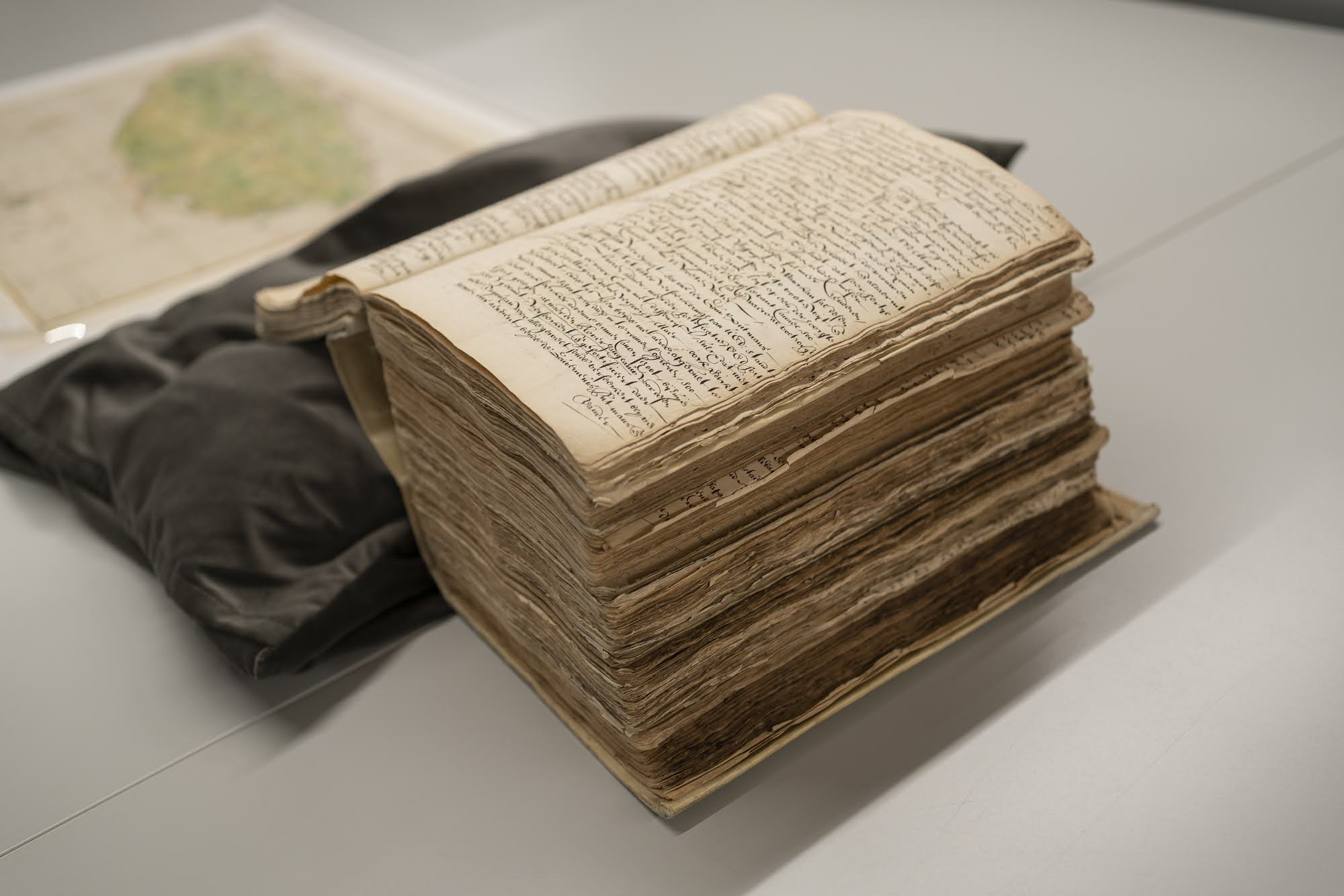
Many archives related to the Dutch colonial past have been digitised in recent years. From the archives of the VOC and WIC to early modern family, notarial, and business archives. These archives are closely intertwined with the colonial past itself. They contain information that sheds light on the (everyday) consequences and experiences of colonialism worldwide. These archives also provide access to information about non-European societies that is often not preserved in other ways. Colonial archives are often literally world heritage. More and more archives are therefore being made accessible through digitisation and text recognition. But as rich and diverse as these archives are, they are not neutral.
Challenges and questions
The symposium Colonial archives and meaningful digital infrastructure explores challenges, questions, and examples surrounding digital access and enrichment of shared resources related to the colonial past.
- How can digital infrastructure contribute to making unique information about the people and societies affected by or resisting colonialism findable and researchable?
- How can multiple perspectives and the many voices in these archives be made more visible?
- How can we ethically employ new techniques?
- And who are the true beneficiaries of advanced access and research infrastructure?
- Who should these initiatives serve, and how can global stakeholders beyond Dutch and professional users be reached (such as the descendants of colonized societies and of those societies whose pasts can be reconstructed using these archives)?
New approaches
Last spring, the advice Dealing with shared sources of the colonial past. Advice on repair and restitution in relation to colonial archives by the Dutch Council for Culture called attention to the role that a responsible handling of colonial archives can play in a better understanding of the impact of colonialism worldwide and its legacies to the present day. It also emphasised that colonial archives themselves are often tools that serviced colonial rule, and whose accessibility has often accentuated the flawed and one-sided perspectives that they bear.
New approaches are thus key to ensuring that new digital access and user infrastructures do not amplify colonial distortions or injustices, but instead contribute to dialogues in, and between, former colonizer and colonised societies. This leads to the question: how can digital infrastructures for colonial archives contribute to a better understanding of past and present in a complex world of present-day inequalities and memory cultures?
Program and practical information
09.30 – 10.00 Coffee outside the symposium room MM 00.029
10.00 – 10.15 Welcome
Liedeke Plate, professor and director Radboud Institute for Culture and History, specialized in art, culture and inclusion
Matthias van Rossum, professor Radboud University and researcher IISH Amsterdam, specialized in colonial and labour history
10.15 – 11.00 Panel: Colonial archives, worldwide relevance and the potential of digital unlocking
Rita Tjien Fooh, national archivist and director National Archives of Suriname, and President Forum of National Archivists
Nadeera Rupesinghe, director general National Archives of Sri Lanka and historian of VOC Sri Lanka
Margo Groenewoud, specialist in colonial archives and digital humanities and historian of the Caribbean
Wisaal Abrahams, visual producer, visual artist and researcher of South African society and history
Nancy Jouwe, cultural historian and researcher, expert in (post)colonial pasts and present, member of the Dutch Council of Culture (Raad voor Cultuur)Moderator: Wim Manuhutu, heritage specialist and historian VU University, specialized in Moluccan and colonial history
11.00 – 12.00 Text recognition, and then what? Towards meaningful infrastructures for complex archives
Onsland.nl, presented by Thomas van Maaren, community manager WO2Net and Onsland
GLOBALISE, presented by Kay Pepping, Brecht Nijman, Stella Verkijk, team members and researchers GLOBALISE
HUF-project, presented by Hylkje de Jong, professor history of law VU University and projectleader of the Staten van Holland-Utrecht-Friesland projectChair: Lodewijk Petram, historian Huygens Institute, specialized in financial and public history
12.00 – 13.00 Lunch break
Lunch is not included, but there is the possibility to visit the Grand Café Iris (Maria Montessori building) or the Refter (Erasmus building).
12.30 – 13.00 Coffee outside the symposium room MM 00.029
13.00 – 14.00 Biased structures in the archive as challenge and source
Combatting Bias, Amber Zijlma and Mrinalini Luthra
Exploring Slave Trade in Asia, Britt van Duijvenvoorde, Pascal Konings
GLOBALISE dataset on ethnic, racial and social categories, Dung Pham, Henrike Vellinga
Resilient Diversity court records database, presented by Elisabeth Heijmans and Sophie RoseChair: Lodewijk Petram, historian Huygens Institute, specialized in financial and public history
14.00 – 15.00 Slotpanel: Can we reach new audiences? Ways forward for digital infrastructures and colonial archives
Manjusha Kuruppath, team leader at the digital infrastructure project GLOBALISE and historian of the VOC and colonial encounters
Mark Ponte, historian and researcher Stadsarchief Amsterdam, specialized in subaltern and micro-histories
Luc Bulten, historian, lecturer at Radboud University and researcher at Cambridge University, specialized in colonial and non-western history
Stephanie Welvaart, sociologist, independent researcher and specialist in heritage and memory of sensitive and colonial historiesModerator: Melinda Susanto, historian, outreach manager GLOBALISE and PhD researcher Leiden University
Inaugural Lecture
After the symposium, attendees are invited to join the inaugural lecture of GLOBALISE project leader Matthias van Rossum (in Dutch) at 15:45, titled De ‘jongens’ van Bontekoe? Over nut en noodzaak van mondiale geschiedenissen van kolonialisme en arbeid. Separate registration is required through the form on the Radboud University announcement page.
Organizers
- GLOBALISE
- Combatting Bias
Register now to participate in the symposium in person or online.
- Colonial archives and global significance
- Announcement: Inaugural Lecture by Matthias van Rossum
GLOBALISE is delighted to announce the inaugural lecture of its project leader Matthias van Rossum, who has been appointed to the special chair of Global Histories of Labour and Colonialism at Radboud University. His lecture, titled De ‘jongens’ van Bontekoe? Over nut en noodzaak van mondiale geschiedenissen van kolonialisme en arbeid, will take place on Friday, January 24, 2025, at 3:45 PM in the Radboud Aula in Nijmegen. A livestream of the event will be available.
The lecture will be delivered in Dutch.
Registration is required to attend and can be completed via the Radboud University website. For more details and to register, visit Radboud University’s official annoucement.
- GLOBALISE seminar: CAPASIA, The Asian Origins of Global Capitalism
Join us for a seminar presented by the CAPASIA and GLOBALISE projects!
Date: Tuesday, 21 May 2024
Time: 15:00 – 16:00 CEST, drinks afterwards
Location: Room 2.18 of the Spinhuis, Oudezijds Achterburgwal 185, 1012 DK AmsterdamSpeakers
- Maarten Draper (European University Institute)
- Sebastian Majstorovic (European University Institute)
Referent
- Luc Bulten (Radboud University)
Seminar overview
The CAPASIA project analyzes approximately 150 European ‘factories’ established in maritime Asia between 1500-1800. It views these not just as trade locations, but as vibrant hubs of material and information exchanges between Asians and Europeans. The project uses the factories as a lens to explore the Asian origins of global capitalism. In their talk, Maarten Draper and Sebastian Majstorovic will provide an overview of the aims and methodology of the CAPASIA project, including the development of a comprehensive database of these factories. They will also discuss how the CAPASIA and GLOBALISE projects align and build upon each other.
CAPASIA (https://www.capasia.eu/) is a five-year ERC-funded project hosted at the European University Institute in Florence. Its deliverables include a user-friendly website that will serve as a repository for data on the factories, a meeting place for scholars, and a medium for decolonizing histories of global capitalism. GLOBALISE (https://globalise.huygens.knaw.nl/), a five-year NWO-funded project based at the Huygens Institute in Amsterdam, focuses on making the VOC archives more accessible to researchers.
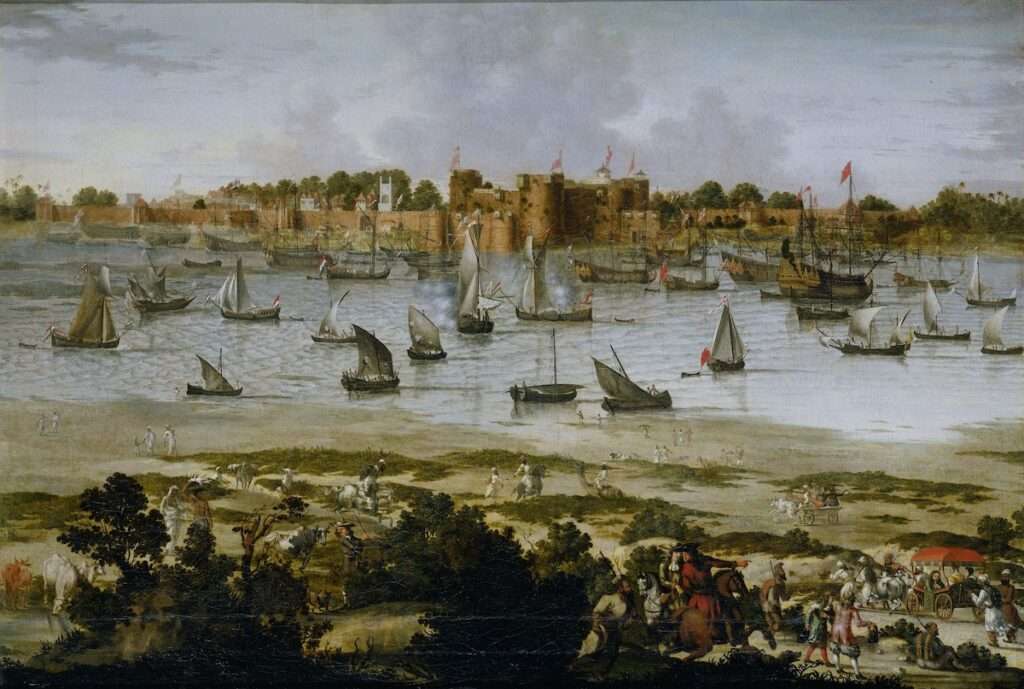
View of the Harbor of Sūrat (Gujarāt), anonymous, c. 1670 Rijkmuseum, SK-A-4778, CC0 - GLOBALISE Datasprint: What on Earth is This? Defining, Labeling and Classifying Early Modern Commodities
Date: Monday 4 December
Time: 13:00 – 16:15
Location: Room F0.01 at the Humanities Labs, University of Amsterdam (Bushuis, Kloveniersburgwal 48 Amsterdam).
Parallel sessions will be organised for online participants.
Registration: Eventbrite
Tools: Bring your own laptop!Are you a historian or a student of history at university with a keen interest in trade, material culture, commodity histories or just good old historical research? If yes, we at the GLOBALISE Project (KNAW Humanities Cluster), in collaboration with the CREATE Lab (UvA), invite you to participate in a workshop to contribute to and enrich our thesaurus of commodities traded in the early modern Indian Ocean world.
As part of our effort to contextualise the contents of millions of pages from the VOC archives, we are creating a glossary and taxonomy of hundreds of commodities that were traded by the Dutch East India Company and local communities. We plan to publish the first online version of the dataset shortly. Owing to the size of the Dutch East India Company archives, this makes this corpus the potentially single largest source available to uncovering the history of the region. For this reason, we believe that our commodities dataset will be of indispensable use for researching these archives and writing new histories of trade and consumption in the Indian Ocean in the period.
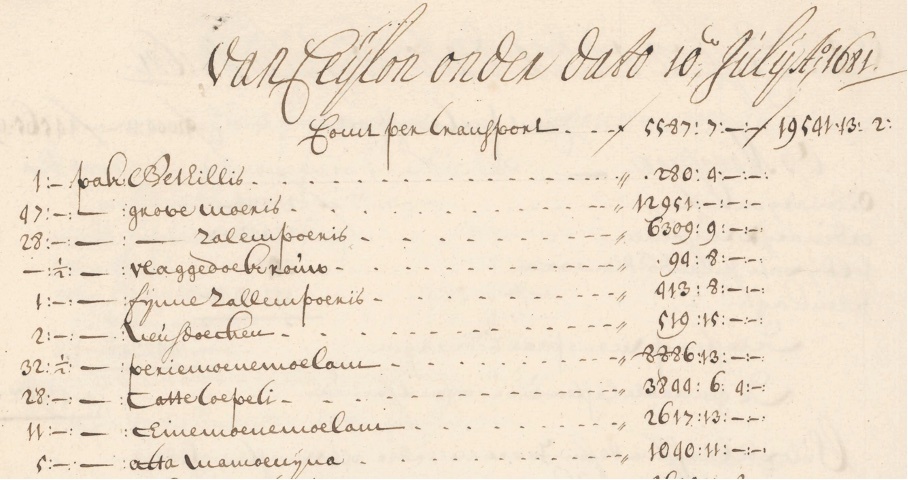
An example of a cargo list with textiles from Ceylon in the VOC archive, with several packs of bethilles, moeris, vlaggedoek, salempoeris, neusdoeken and periemoenemolam. Nationaal Archief, CC0. We would like to invite you to participate in a half-day datasprint where we will research the definition of commodities, scour the VOC archives and other sources to find alternative labels for these goods, and even categorise commodities in groups that would be interesting and valuable for your own research. This will be the perfect opportunity to sink your teeth into the archives of the Dutch East India Company, learn more about commodities that crossed the early modern seas, deploy your skills of historical research, interact with like-minded students and scholars, and contribute to the creation of a vital, shared resource.
Programme
13:00 – 13:15 Introduction
13:15 – 14:15 Sprint part 1
14:15 – 14:30 Break
14:30 – 14:45 Commodity Stories
14:45 – 15:45 Sprint part 2
15:45 – 16:15 Closing discussion - GLOBALISE HTR Launch
Date: Wednesday 4 October 2023
Time: 12:15 – 17:30 CEST
Location: International Institute of Social History, Cruquiusweg 31, 1019 AT Amsterdam
Registration (required): EventbriteGLOBALISE is pleased to announce that the first results of the project are now available to all. You are warmly invited to find out more at an event hosted by the International Institute of Social History in Amsterdam, on Wednesday 4 October 2023 from 12:15 to 17:30 CEST.
The program features the launch of a simple viewer for searching and browsing the transcriptions, and sessions in which the team will share updates on the project and future plans. Also, participants can search through the transcriptions in a hands-on workshop session (and perhaps find that one obscure reference they were looking for!). Finally, there will be short presentations of recent research with the VOC archives and time for discussion.
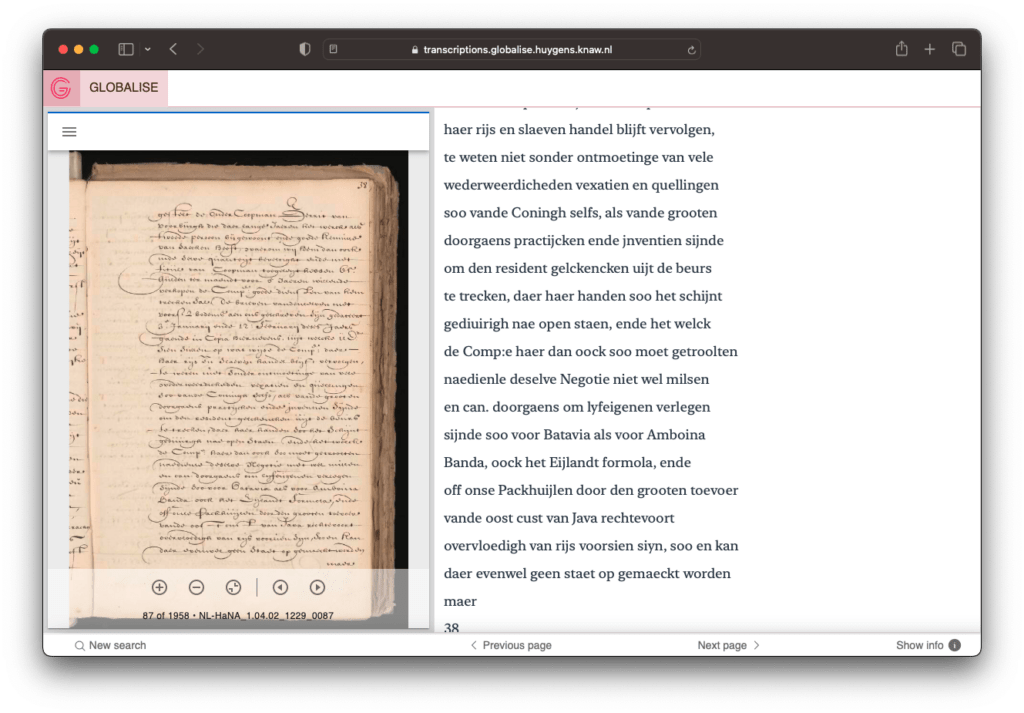
Screenshot of the GLOBALISE transcriptions viewer Please note that this event will be on site in Amsterdam.
Programme
12:15 – 13:00 Walk-in lunch (upon registration)
13:00 – 13:20 Introduction and updates
13:20 – 14:00 Workshop: working with the VOC transcriptions
14:00 – 14:15 Break
14:15 – 14:50 Research presentations
14:50 – 15:25 Reflections
15:25 – 15:50 Break
15:50 – 16:40 Looking ahead, Q&A
16:50 – 16:45 Closing remarks
16:45 – 17:30 Drinks
- GLOBALISE Datasprint: Mapping Places in the Indian Ocean World
In collaboration with the CREATE Lab, University of Amsterdam
Date: Monday 15 May 2023
Time: 13:00 – 17:00 CEST
Location: Bushuis F0.01, Kloveniersburgwal 48, 1012 CX Amsterdam
Registration: via EventbriteIntroduction
Historical places are important building blocks for the reconstruction of historical events. The GLOBALISE corpus of about 5 million pages from the VOC archives describes hundreds of thousands of events that took place over a period of two centuries in a large number of locations spread over a huge area around the Indian Ocean and Indonesian archipelago. Thanks to initiatives like the Atlas of Mutual Heritage and the World Historical Gazetteer, we can locate some of the places mentioned, but by no means all of them. Within GLOBALISE, we would like to bring as much of these locations to light as possible by creating a dataset that identifies and geolocates historical places mentioned in our texts. This is challenging, as disambiguation of spelling variations is not always easy, place names appear in different languages, change over time, and sources present ambiguous references to locations.
This datasprint aims to foster collaboration between historians, heritage professionals and data scientists for better availability of data on historical places. It intends to curate, publish, and link data on historical places collected by researchers within their own projects, as well as test and improve digital techniques to extract, structure, and share data on places. In addition to data creation, curation, and linking, this datasprint will offer a space to exchange knowledge and expertise on historical places and contexts, and digital techniques. We hope that by the end of the datasprint, all participants will have learned something, and that we will have generated valuable data on historical locations with which to improve our understanding of the early modern Indian Ocean and Indonesian archipelago worlds.
Sessions
The datasprint consists of three simultaneous sessions on georeferencing, data extraction, and data linking respectively. Everyone with an affinity or interest in (early modern) maps, history of the Indian Ocean World, or digital techniques for data extraction, is welcome to join regardless of technical / historical proficiency!
Georeferencing early modern maps
Chair: Jules Schoonman (TU Delft)
Preparation: None.
Tools: Your own laptop with an up-to-date browser (preferably Firefox or Chrome) with javascript enabled.Digitised historical maps can be challenging to read and compare to modern-day maps, due to their difference in style, orientation, map projection and more. In these scenarios, it is helpful to georeference a map by relating several points to geospatial coordinates. On the basis of this information, the map can be used as an overlay in interactive web maps or GIS-applications, allowing for direct comparison between then and now. Other use cases include drawing geospatial data on the historical map or, conversely, the vectorisation of its features. Traditionally, such methods require the creation of derivatives, duplicate server infrastructures, and the use of proprietary software–often not resulting in open and reusable data.
This session introduces Allmaps, a new set of open-source tools to georeference, view and explore digitised maps from institutions supporting the International Image Interoperability Framework (IIIF). Using the sub-collection of maps from the Atlas of Mutual Heritage originating from the National Archives, we will (1) learn about IIIIF and how to find the right endpoints, (2) georeference maps in the Allmaps Editor, (3) learn about the format of a Georeference Annotation, (4) view the map in the Allmaps Viewer, (5) explore other uses for georeferenced maps.

A Dutch Map of Buton Island from 1749 as an overlay on a modern map. (Source: Allmaps) Data extraction from early modern maps
Chair: Melvin Wevers (University of Amsterdam)
Preparation: None.
Tools: Your own laptop with an up-to-date browser (preferably Firefox or Chrome) with javascript enabled.A substantial collection of historical location data for the Indian Ocean and Indonesian archipelago worlds is already available, notably in the Atlas of Mutual Heritage database that provides useful metadata for visual sources such as old maps. We aim to expand on this by, for instance, identifying locations and other geospatial features on a selection of old maps from the National Archives. In this session we will first try to identify the kind of information that can be extracted from old maps (e.g. inhabited places, but also, for example, plantations, mills, and harbours) to come up with an initial annotation framework, after which we will annotate these maps ourselves. The resulting data can be a starting point for automating the information extraction from old maps further.
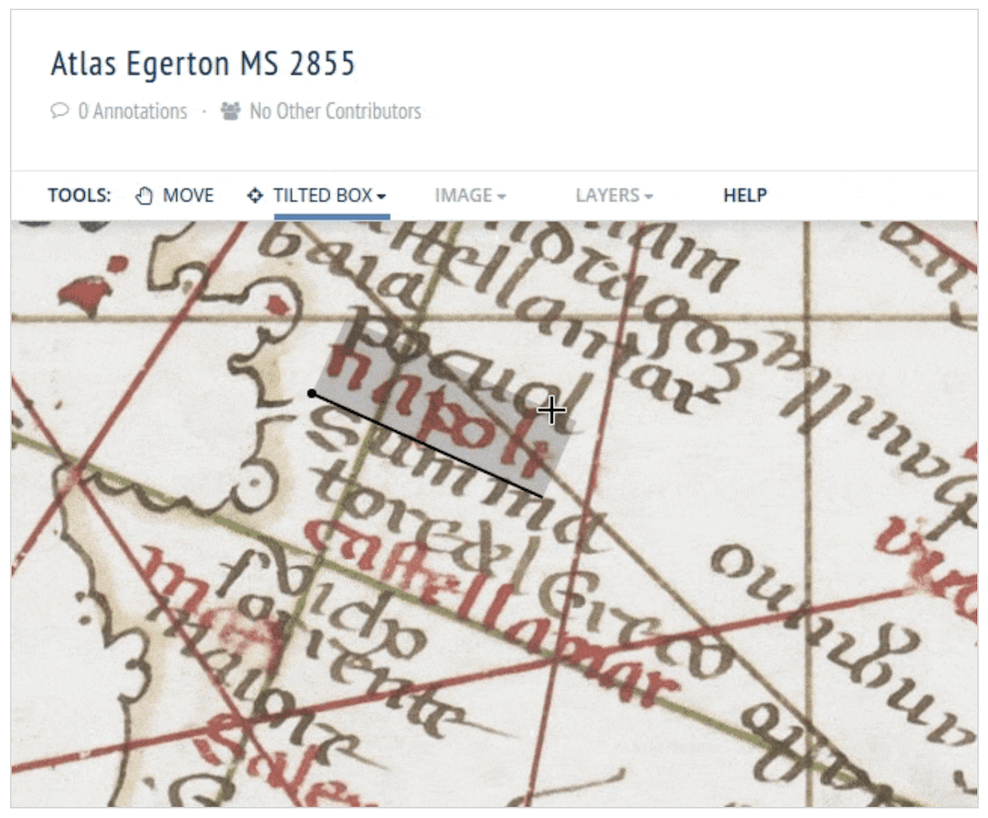
An example of an annotated place on an old map. (Source: Recogito) Curating and linking new places data(sets) via World Historical Gazetteer
Chair: Rombert Stapel (International Institute of Social History)
Preparation (optional): Bring your own data – a clean places dataset and access to your own dataset during session.
Tools: Your own laptop.Do you have a finished or in-progress dataset on historical locations originating from your research or personal project and would you like to be able to geolocate these places and enrich your data with other historical data? In this session, we will work together to curate locations datasets to then upload them to the World Historical Gazetteer database and link them to other places in the WHG index – generating new, accessible, and reusable data on historical places.

An overview of places from the Atlas of Mutual Heritage database indexed in the World Historical Gazetteer. (Source: World Historical Gazetteer) Programme
13:00 Introduction
13:45 Breakout sessions: start
15:00 Break
15:15 Breakout sessions: wrapping up
16:00 Session results and conclusions
16:30 Reflection
17:00 Drinks
- GLOBALISE seminar: Historical Events and Frames Annotation Processes
28 NOVEMBER 2022
- Jens Aurich (Junior Researcher | International Institute for Social History)
“Finding and Annotating Collective Labour Actions in Newspapers with INCEpTION” - Stella Verkijk (Developer | GLOBALISE)
“Towards Automatic Event Detection in VOC Documents”
Date: Monday, 28 November 2022
Time: 15:00 – 16:30 CET
Location: Spinhuis room 2.18* & Zoom
*Huygens Institute: Oudezijds Achterburgwal 185, 1012 DK Amsterdam - Jens Aurich (Junior Researcher | International Institute for Social History)
- GLOBALISE seminar: Classification of Historical Data and Collections
31 OCTOBER 2022
- Shannon van Muijden (Datamanager | Zuiderzeemuseum)
“Classification and Linked Data for Heritage Collections” - Toine Pieters (Professor | Utrecht University)
“Classification of pharmaceutical and botanical data in TimeCapsule” - Kay Pepping (Junior Researcher | GLOBALISE)
“Creating a commodity classification for the Indian Ocean World”
Date: Monday, 31 October 2022
Time: 15:00 – 16:30 CET
Location: Spinhuis room 2.18* & Zoom - Shannon van Muijden (Datamanager | Zuiderzeemuseum)
- GLOBALISE seminar: Writing Global Histories with the VOC Archives
26 SEPTEMBER 2022
What kind of information do the VOC archives contain, how do we use them to write histories and what difficulties do we face in the process?
During this seminar, we will look at the VOC archives from a researcher’s point of view in light of different projects.
With presentations by:
- Hanna te Velde (Researcher | VU Amsterdam)
“Women and their strategies for socio-economic mobility in VOC and WIC settlements” - Maarten Manse (Researcher | VU Amsterdam)
“The VOC archives as a lens on early modern globalisation” - Manjusha Kuruppath (Researcher | GLOBALISE)
“From VOC archives to datasets and back”
Date: Monday, 26 September 2022
Time: 15:00 – 16:30 CEST
Location: Spinhuis room 2.18* & Zoom - Hanna te Velde (Researcher | VU Amsterdam)
- GLOBALISE seminar: Entity Modelling and Historical Observations
27 JUNE 2022
- Claude Chevaleyre (Researcher | Bonn University)
Modelling Observations of Slave Trade and Human Trafficking - Leon van Wissen (Data Engineer | GLOBALISE)
Modelling Globalise Pilot Data
Date: Monday, 27 June 2022
Time: 15:00 – 16:30 CEST
Location: Spinhuis room 2.18* & Zoom
*Huygens Institute: Oudezijds Achterburgwal 185, 1012 DK Amsterdam - Claude Chevaleyre (Researcher | Bonn University)
- GLOBALISE seminar: Entity Linking and (the Trouble of) Historical Data
30 MAY 2022
- Bas van den Brink (Student | UvA)
Entitity Linking in Structured Data on Slave Trade - Megan Hadasa Leal Causton (Researcher | National Archives)
Entity Linking in Structured Data and HTR-ed Archival Series - Gerhard de Kok (Researcher | GLOBALISE)
Entity Linking in Structured and Linked Data on VOC Ships
Date: Monday, 30 May 2022
Time: 15:00 – 16:30 CEST
Location: Spinhuis room 2.18* & Zoom - Bas van den Brink (Student | UvA)
- GLOBALISE kickoff
11 MAY 2022
Location: International Institute for Social History, Amsterdam & Zoom
See this blog post by Merve Tosun to learn more about the GLOBALISE kickoff meeting.
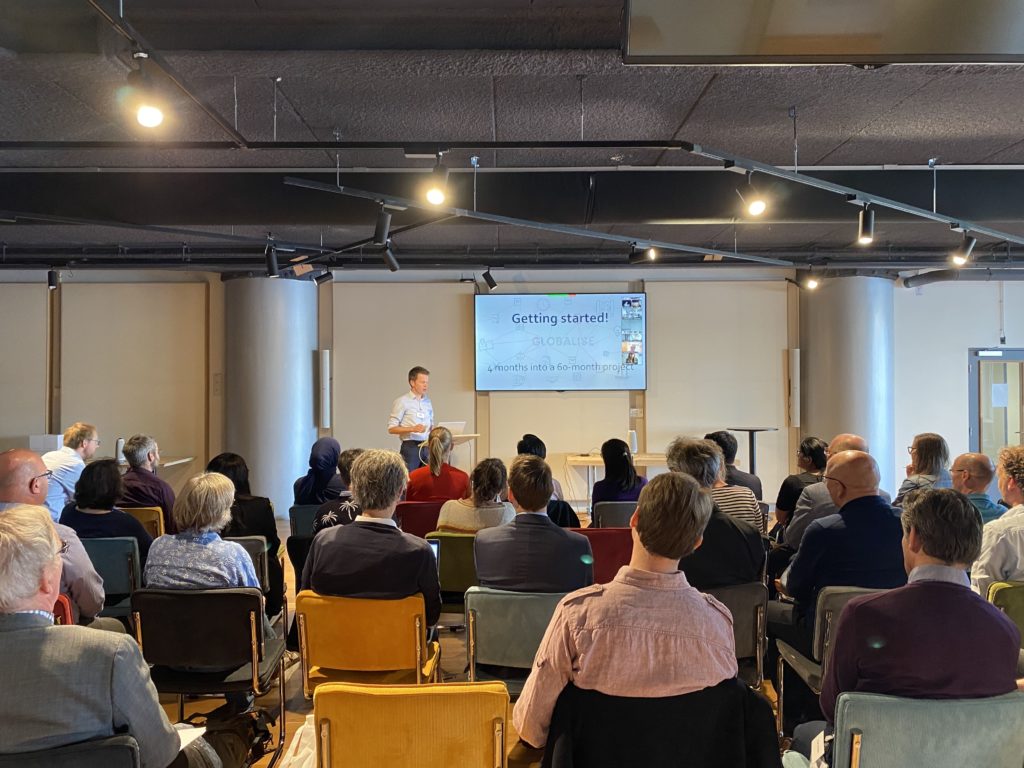
Getting started!